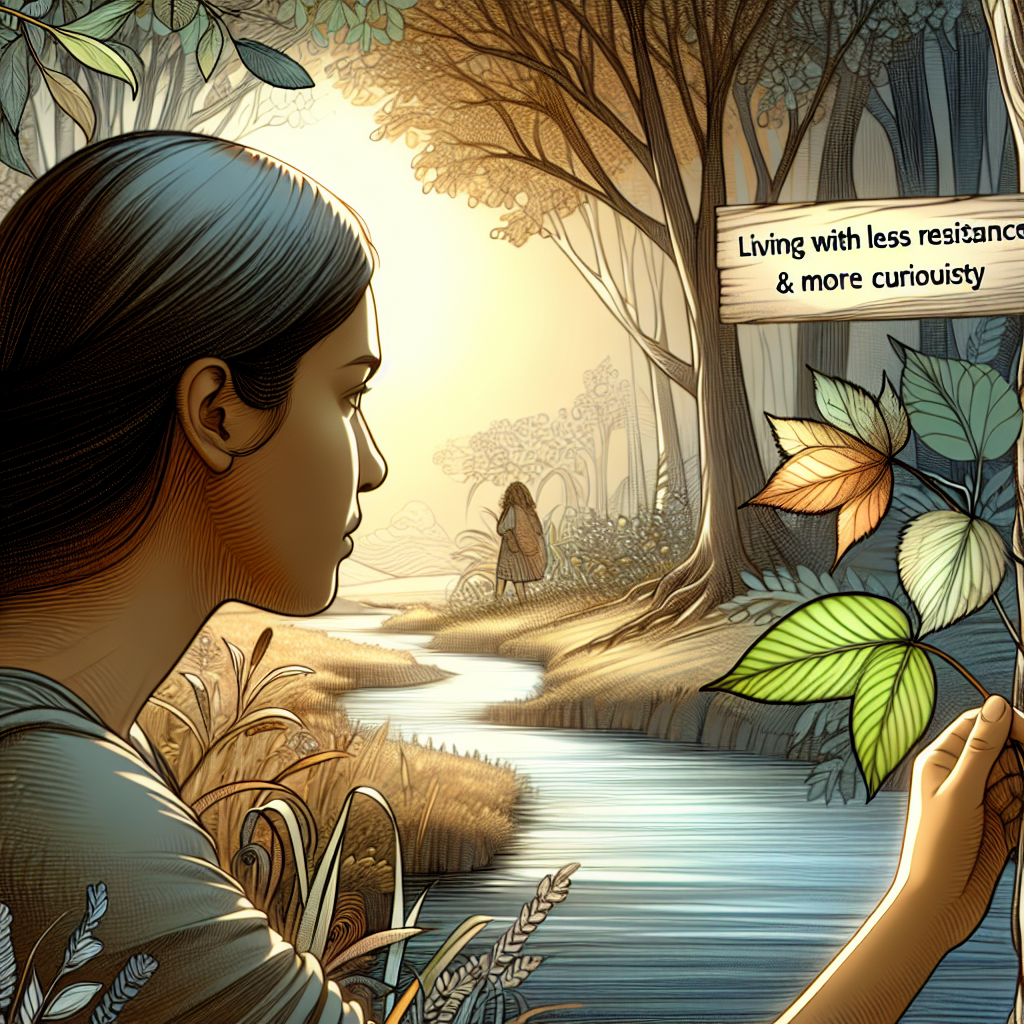
Living with Less Resistance and More Curiosity
Introduction
Many people feel pulled between the urge to control life and the wish to explore it. Resistance often rises when events do not match our plans. Curiosity invites us to look closer and to learn. Living with less resistance and more curiosity does not promise a problem free path. It builds capacity to meet reality with clarity and care. This article offers a practical and reflective guide for that shift. You will find a clear framework, tested practices, and examples that apply at work and at home.
What Resistance Looks Like
Resistance is a felt push against what is present. It can show as tension in the body or as rigid thoughts that say this should not be happening. We may argue with facts or delay decisions. We may defend old habits even when they no longer serve. Resistance can also be subtle. A quiet refusal to ask for help. A habit of judging new ideas before they are fully heard. A tendency to explain away feedback. In each form the core message is the same. I must not allow this.
What Curiosity Offers
Curiosity is an active search for understanding. It does not mean agreement and it does not require passivity. It asks what is here and what can be learned. Curiosity is grounded and discerning. It invites presence, questions, and new choices. It widens options and lowers fear. In daily life curiosity improves dialogue, fuels innovation, and strengthens relationships. Curiosity also protects dignity. When you inquire into a situation you honor your needs and the needs of others.
Benefits of Choosing Less Resistance and More Curiosity
- Lower stress through a more flexible response to change
- Better decisions through richer information and fewer blind spots
- Stronger relationships through open listening and mutual respect
- Greater creativity through exploration and play
- Faster learning through feedback and iteration
- Higher resilience through meaning making and adaptive action
A Brief View from Science
Modern psychology links resistance with threat responses. The body mobilizes for fight, flight, or freeze. Perception narrows. The mind favors certainty and quick closure. Curiosity supports a broader view. It opens attention. It allows nuance and pattern recognition. Studies in education and organizational behavior show that curiosity supports engagement and mastery. It also reduces errors because people are more likely to ask clarifying questions and to surface risks early. Over time this shift becomes a skill. With practice the body learns that exploration is safe enough. That belief changes outcomes.
Mindset Shifts That Reduce Resistance
Adopt a learning stance. Replace the need to be right with the aim to get it right. That single change lowers defensiveness.
Favor clarity over certainty. Clarity focuses on what you know and what you do not yet know. It guides next steps. Certainty demands closure even when data are thin.
Use and yet as a bridge. I dislike this and yet I am willing to understand it. I feel afraid and yet I can ask a small question. And yet links honesty with movement.
Name what you control. Separate effort from outcome. Focus on actions and choices that are within reach.
Expect partial answers. Most real problems do not have neat endings. Curiosity stays active through the unknown.
Daily Practices to Build Curiosity
Start the day with an intention. Choose a focus such as ask one sincere question in every meeting or notice moments of tension and breathe before speaking.
Use a brief check in at midday. Ask what surprised me today and what did I learn. Write one sentence. Keep it simple and consistent.
Create a curiosity cue. Pick a neutral signal such as a phone vibration or a doorway. Each time you notice the cue ask one open question. For example what else could be true.
Practice micro pauses. Take three slow breaths before you offer an opinion. The pause reduces reactivity and invites inquiry.
Close the day with a review. Note one moment of resistance and one moment of curiosity. Identify what helped and what hindered.
Communication With Curiosity
Curious communication begins with listening for meaning rather than listening to reply. Paraphrase what you heard to confirm understanding. Ask short open questions that begin with what or how. Avoid leading questions. Invite stories rather than defenses. Share your perspective as a view not as a verdict. Track tone and pace. Slow speech signals care and reduces heat. When conflict rises, name it simply. We see this differently. I want to understand your view. Such statements set a cooperative frame without surrendering your position.
Curiosity in Decision Making
Decisions improve when you separate exploration from commitment. Create a discovery phase that values options and learning. Then create a commit phase with clear criteria. During discovery ask diverse voices for input. Test extreme scenarios. Seek out disconfirming data. During commitment define the decision owner and the timeline. List tradeoffs openly. Document the rationale. This balanced rhythm prevents endless debate and also guards against premature closure.
Curiosity and Creativity
Creative work thrives on breadth and depth. Breadth comes from exposure to varied fields and methods. Depth comes from attention and practice. Build breadth through deliberate sampling of books, talks, and people outside your domain. Build depth through focused sprints that work one idea far enough to learn from it. Hold ideas lightly until they prove value. Kill ideas kindly when they do not. Curiosity supports both sides. It loves to roam and it is not afraid to refine.
Meeting Uncertainty With Skill
Uncertainty is the natural habitat of curiosity. Resistance seeks to wipe out uncertainty through control. Curiosity seeks to map it. Mapping means you identify knowns, unknowns, and assumptions. You plan small tests. You watch signals. You adapt. This approach fits personal choices as well as strategic projects. When facing a career shift, map your skills, interests, and constraints. Test a path through a small project or an informational interview. Learn and adjust. You do not need perfect foresight. You need honest data and iterative action.
Habits and Rituals That Support the Shift
Habits encode values into action without constant willpower. Choose rituals that mark transitions. A morning ritual that sets intention. A pre meeting ritual that names your goal for listening. A post meeting ritual that captures one insight. Add environmental design. Place a notepad where you tend to rush. Use visual cues that remind you to ask before you assume. Build tiny rewards that reinforce the behavior. A brief walk after a tough conversation. A note of gratitude to yourself after you try a new approach.
Leadership and Teams
Teams flourish when leaders model curiosity. Leaders set norms through questions. What problem are we trying to solve. What evidence would change our view. What risks are we not seeing. Leaders show courage by admitting unknowns. That honesty raises trust. Meetings also improve with a curious structure. Begin with a clear purpose and outcomes. Invite two minutes of silent review for key documents. Rotate the role of devil advocate to surface blind spots without blame. Close with decisions, owners, and next steps so that inquiry leads to action.
Curiosity at Home and in Relationships
Relationships deepen through attention and respect. Curiosity is a form of care. Ask about the experience under the surface. Notice emotions and needs. Reflect them back in simple words. Offer empathy before advice. When you disagree, focus on interests not positions. Share the story you are telling yourself and invite correction. Agree on experiments. Try a change for a week and review. Small tests keep discussions grounded and hopeful.
Digital Life With Less Resistance
Digital spaces reward speed and certainty. They can inflame resistance and shrink curiosity. Set healthy rules. Limit news checking windows. Curate your feeds for diverse sources and high standards. Pause before you share. Verify facts. Ask what value you add. Choose formats that support depth such as long form essays or podcasts. Create tech free zones for conversation and reflection. Protect attention as a precious asset.
Common Obstacles and How to Move Through Them
Perfectionism keeps you stuck. It sets a bar that blocks action. Replace it with a standard of clear progress and learning.
Fear of judgment silences inquiry. Reframe questions as a service to the group. You help the whole room when you seek clarity.
Time pressure pushes quick fixes. Schedule micro windows for exploration. Even three minutes of inquiry can prevent hours of rework.
Habit loops pull you back. Tie new habits to existing routines and track them with simple marks on a calendar.
Cynicism hides as wisdom. It says nothing will change. Test that claim with one small experiment. Let results speak.
A Step by Step Plan for the Next Thirty Days
- Choose a single theme for the month such as ask before I assume
- Identify two daily cues that will remind you to practice your theme
- Share your theme with a partner and request weekly check ins
- Define a small metric you can track such as questions asked per meeting
- Set a morning intention in one sentence each day
- Use a three breath pause before you respond to tension
- End each day with a five line journal on resistance and curiosity moments
- Run one small experiment each week that tests a new approach
- Review outcomes each Friday and capture lessons learned
- Celebrate visible progress in a simple way to reinforce the habit
Powerful Questions to Cultivate Curiosity
- What is the real problem we are trying to solve
- What assumptions am I making right now
- What evidence would change my mind
- What am I not seeing that could be important
- What are three possible next steps that are small and safe to try
- What does a good outcome look like for all involved
- What would this look like if it were easy
- What is one fear I can name so it loses force
- What can I learn from this even if I do not like it
- What support would make progress more likely
Stories and Reframes
Consider a project that faces a late change in scope. Resistance says this is unfair and impossible. Curiosity asks what is essential and what can be traded. It seeks constraints and negotiates a viable path. It may not save every feature. It often saves the goal.
Consider feedback that stings. Resistance deflects and blames. Curiosity parses the message. It looks for signal and sets a plan for growth. It may ask a follow up question to gain context. Curiosity preserves dignity without denying facts.
Consider a career plateau. Resistance insists on instant transformation. Curiosity explores interests and strengths. It sets a series of small tests. It grows skills and networks. It turns a stuck season into a fertile field.
Ethics of Curiosity
Curiosity without care can become intrusion. The ethical frame matters. Seek consent before deep inquiry. Respect privacy. Use information to support growth not to gain leverage. Pair curiosity with compassion and responsibility. This pairing builds trust and protects relationships.
Measuring Progress
Progress shows up in small ways. You notice tension sooner. You ask one more question before you push back. You recover faster after conflict. Meetings feel clearer and calmer. You capture and act on lessons from mistakes. You sustain attention on problems that matter. Track these signals in a simple log. Review monthly to see patterns. Adjust and continue.
Sustaining the Practice
Motivation rises and falls. Systems sustain you when motivation dips. Keep tools visible. Keep goals simple. Return to the basics after a setback. Share the journey with peers. Teach what you are learning. Teaching cements insight and builds community. Remember that curiosity is a renewable resource. The more you use it the more available it becomes.
Closing Reflection
Life will always include difficulty and change. Resistance fights reality and drains energy. Curiosity meets reality and unlocks choice. The shift is practical and human. It is built through small moments and repeated acts. Ask honest questions. Pause before judgment. Run small experiments. Learn and adjust. With time the default posture changes. You move through the world with less strain and more wonder. You create value for yourself and for those around you. This is not an abstract ideal. It is a daily practice that you can begin today.
